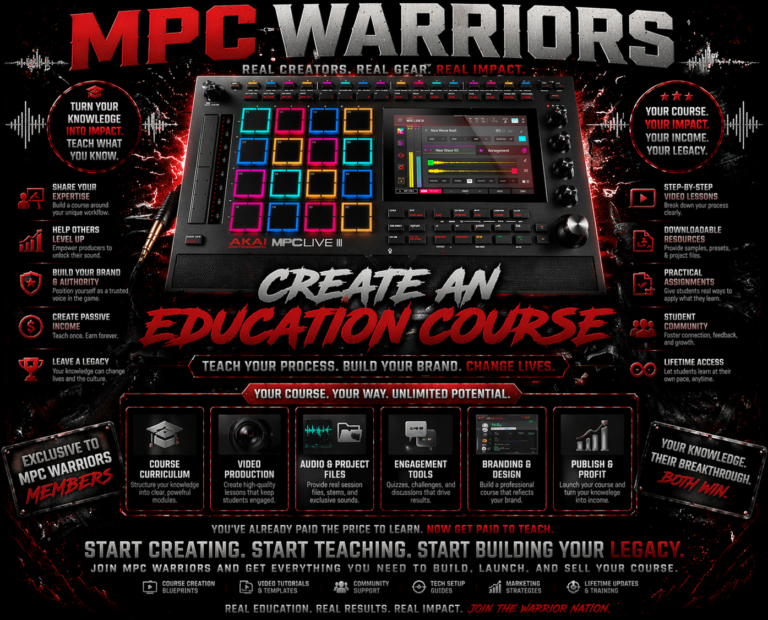
What to Do After You Create an Educational MPC Course: From Launch to Long-Term Growth
Creation is only Phase One
Most creators believe the hard part is building the course.
It’s not.
The real work begins after the course is complete.
Creating an MPC course gives you a product.
But what you do next determines whether that product becomes:
- A one-time release
or - A scalable system that builds income, authority, and long-term growth
The difference is not in the content.
It is in the strategy that follows.

1. Launch With Clarity, Not Confusion
Once your course is complete, your first objective is to launch with a clear message.
Your audience needs to understand:
- Who the course is for
- What problem it solves
- What transformation it delivers
Avoid vague positioning.
Instead of:
“Learn the MPC”
Position it as:
“Go from beginner to building full beats with a structured MPC workflow”
Clarity increases conversion.
People do not buy courses—they buy outcomes.
2. Build a Content Engine Around the Course
Your course should not sit quietly on a page.
It should be supported by consistent content.
Turn your course into:
- Short-form videos (tips, clips, breakdowns)
- Tutorials (micro-lessons)
- Behind-the-scenes sessions
- Problem-solving content
Each piece of content should:
- Provide value
- Demonstrate your expertise
- Lead back to your course
Content becomes your marketing system.
Without content, your course remains invisible.
3. Create a Funnel, Not Just a Sales Page
A single sales page is not enough.
You need a funnel—a structured path that moves people from interest to purchase.
A simple funnel might include:
- Free content (social media, YouTube)
- Lead magnet (free guide, sample pack, mini lesson)
- Email sequence
- Course offer
This allows you to:
- Capture attention
- Build trust
- Nurture potential students
- Increase conversions
The goal is not just traffic.
The goal is guided movement.
4. Build an Email List Immediately
Social media gives you reach.
Email gives you ownership.
After launching your course, prioritize building an email list by offering:
- Free MPC starter guides
- Beginner cheat sheets
- Sample packs
- Mini training sessions
Your email list becomes:
- A direct communication channel
- A promotion platform
- A long-term asset
Algorithms change.
Your list stays.
5. Create a Community Around Your Course
Courses teach.
Communities retain.
By building a space where students can:
- Ask questions
- Share progress
- Receive feedback
- Connect with others
You increase:
- Engagement
- Completion rates
- Customer satisfaction
This can be:
- A private group
- A membership platform
- A structured learning community
People are more likely to stay committed when they are not learning alone.
6. Gather Feedback and Refine
Your first version is not the final version.
After students begin using your course:
- Identify where they struggle
- Note common questions
- Observe drop-off points
Use this information to:
- Improve lessons
- Add clarity
- Create new modules
Feedback turns a good course into a great one.
7. Expand Into Multiple Offers
A single course is a starting point—not the end.
After your initial course, you can expand into:
- Advanced MPC workflows
- Mixing and mastering modules
- Content creation using MPC
- Sample pack creation courses
- Business and monetization strategies
You can also introduce tiers:
- Basic access
- Advanced training
- Elite program with coaching
This builds an ecosystem, not just a product.
8. Repurpose Your Course Into Multiple Assets
Your course contains valuable content that can be repurposed into:
- YouTube videos
- Short-form clips
- Blog articles
- Social media posts
- Email content
This multiplies your reach without creating from scratch.
One course can generate:
- Dozens of videos
- Hundreds of posts
- Continuous engagement
Efficiency creates scale.
9. Position Yourself as an Authority
Your course is not just a product—it is proof of expertise.
Use it to:
- Speak with confidence
- Teach publicly
- Build credibility
- Attract opportunities
When people see that you:
- Teach clearly
- Deliver results
- Provide structure
You move from:
- Producer
to - Authority
Authority opens doors that skill alone cannot.
10. Focus on Long-Term Systems, Not Short-Term Sales
It is easy to chase quick sales.
But real success comes from building systems that:
- Generate consistent traffic
- Convert reliably
- Retain customers
- Expand over time
This includes:
- Content systems
- Email marketing
- Product ecosystems
- Community engagement
Short-term sales create spikes.
Systems create sustainability.
11. Track Performance and Optimize
After launching, monitor:
- Conversion rates
- Engagement levels
- Content performance
- Email open rates
This helps you:
- Identify what works
- Improve weak areas
- Scale effective strategies
Data removes guesswork.
12. Stay Active in the Process
Your course should not feel abandoned.
Continue to:
- Engage with students
- Update content
- Provide insights
- Share new techniques
Active creators build stronger brands.
Inactive creators lose momentum.
From Course to Ecosystem
Creating an MPC course is a powerful step.
But the real value comes from what you build around it.
When done correctly, your course becomes:
- A foundation
- A marketing engine
- A revenue stream
- A brand builder
The goal is not just to sell a course.
The goal is to create a system that grows over time.
Final Thought
A course is not the finish line.
It is the starting point of something bigger:
- A platform
- A community
- A business
What you build after determines how far it goes.
Warrior Wake Up
If you’re ready to go beyond just creating a course and start building a full system around your MPC skills:
Join the MPC Warriors Elite Program.
- Learn how to structure your knowledge
- Build your content engine
- Create scalable products
- Grow a real ecosystem
This isn’t just about teaching the MPC.
This is about building something that lasts.
Forge your system. Control your future.dum enim facilisis gravida neque convallis. In hendrerit gravida rutrum quisque.