How to Achieve Professional-Sounding Mixes: From Raw Sound to Refined Records
The Difference Between Good and Professional
Many producers can create a good beat.
Fewer can create a professional-sounding mix.
The difference is not always talent—it is understanding.
A professional mix is not just louder, cleaner, or more polished. It is intentional. Every sound has a place. Every frequency is controlled. Every element works together instead of competing.
If your mixes sound:
- Muddy
- Flat
- Overcrowded
- Weak compared to industry records
The issue is not that you lack ability. The issue is that you may lack a systematic approach to mixing.
Mixing is not guesswork. It is a process..


1. Start With Sound Selection, Not Fixes
The biggest mixing mistake happens before mixing even begins.
Producers often choose sounds that:
- Clash in frequency
- Compete for space
- Lack clarity
Then try to “fix” everything during mixing.
Professional mixes start with strong sound selection.
Choose sounds that:
- Complement each other
- Occupy different frequency ranges
- Already sound close to what you want
If your sounds are right, your mix becomes easier.
If your sounds are wrong, your mix becomes a constant battle.
2. Gain Staging: Control Before Creativity
Before adding effects, you must control your levels.
Gain staging is the process of setting proper volume levels so your mix has:
- Headroom
- Balance
- Clarity
A simple approach:
- Keep your master from clipping
- Lower individual tracks so nothing is overly loud
- Aim for a clean, balanced starting point
If your levels are uncontrolled, no amount of EQ or compression will fix the mix.
Balance is the foundation.
3. Volume Is Your Most Powerful Tool
Many producers overlook the simplest and most effective mixing tool: volume.
Before adding plugins, ask:
- Is anything too loud?
- Is anything too quiet?
- Can I hear every element clearly?
A well-balanced mix with no effects will often sound better than a poorly balanced mix with dozens of plugins.
Professional mixers spend significant time adjusting levels before touching anything else.
Clarity begins with balance.
4. EQ: Creating Space, Not Just Cutting Frequencies
EQ (equalization) is one of the most important tools in mixing—but it is often misused.
EQ is not just about boosting or cutting randomly. It is about creating space.
Use EQ to:
- Remove unnecessary low-end from non-bass elements
- Reduce mud (typically in the low-mid range)
- Carve space so instruments don’t overlap
For example:
- If your kick and bass are fighting, adjust their frequencies so each has room
- If your melody sounds cloudy, clean up excess low frequencies
Think of EQ as a way to organize your mix.
Each sound should have its own lane.
5. Compression: Control Dynamics, Don’t Destroy Them
Compression helps control the dynamic range of your sounds.
It can:
- Even out volume differences
- Add punch to drums
- Stabilize vocals or instruments
But overuse can:
- Flatten your mix
- Remove energy
- Make everything sound lifeless
Use compression with purpose:
- Tighten drums
- Control peaks
- Add consistency
Do not compress everything just because you can.
Professional mixes breathe. They are controlled—but not suffocated.
6. Stereo Space: Width and Placement
A professional mix is not just about what you hear—it is about where you hear it.
Use stereo placement to create width:
- Center: kick, snare, bass, main elements
- Left/Right: melodies, textures, effects
Panning helps:
- Reduce clutter
- Improve clarity
- Create a more immersive experience
If everything is in the center, your mix will feel crowded.
Width creates separation.
7. Reverb and Delay: Depth, Not Distance
Reverb and delay add depth to your mix.
They help create:
- Space
- Atmosphere
- Movement
But too much can:
- Wash out your mix
- Reduce clarity
- Push elements too far back
Use effects intentionally:
- Add subtle reverb to create space
- Use delay for rhythm and movement
- Keep important elements present and clear
Think of depth like layers:
- Front (dry, clear sounds)
- Middle (moderate effects)
- Back (more ambient elements)
Professional mixes feel three-dimensional.
8. Reference Tracks: Your Reality Check
One of the most powerful tools in mixing is comparison.
Use reference tracks:
- In the same genre
- With similar energy
- At a professional level
Compare your mix to theirs:
- Are your drums hitting as hard?
- Is your low-end controlled?
- Does your mix feel as clear?
This helps you identify gaps.
Without references, you are mixing in isolation.
Professional producers constantly compare.
9. Avoid Overprocessing
More plugins do not equal a better mix.
Common beginner mistake:
- Adding multiple EQs
- Stacking compressors
- Overusing effects
This leads to:
- Loss of clarity
- Phase issues
- Overcomplication
Instead, focus on:
- Intentional moves
- Minimal processing
- Clear decisions
A clean mix with fewer tools will outperform a cluttered mix with too many.
10. Finish and Review Your Mix
Do not stay stuck in endless tweaking.
At some point, you must:
- Export your mix
- Listen on different systems
- Take notes
Test your mix on:
- Headphones
- Car speakers
- Phone speakers
- Studio monitors
This reveals:
- Weak points
- Imbalance
- Clarity issues
Then refine—but do not restart from scratch every time.
Improvement comes from iteration, not perfection.
Conclusion: Professional Sound Is Built, Not Found
A professional mix is not achieved through luck.
It is built through:
- Strong sound selection
- Proper balance
- Strategic EQ
- Controlled dynamics
- Intentional space
- Consistent practice
Mixing is a skill that develops over time.
The more you practice with purpose, the more your ear sharpens—and the more your mixes improve.
Final Thought
You do not need expensive gear to achieve a professional sound.
You need:
- Understanding
- Discipline
- Consistency
A focused producer with basic tools and strong fundamentals will always outperform someone relying on plugins without knowledge.
Call to Action
If you’re ready to stop guessing and start creating mixes that actually sound clean, powerful, and professional:
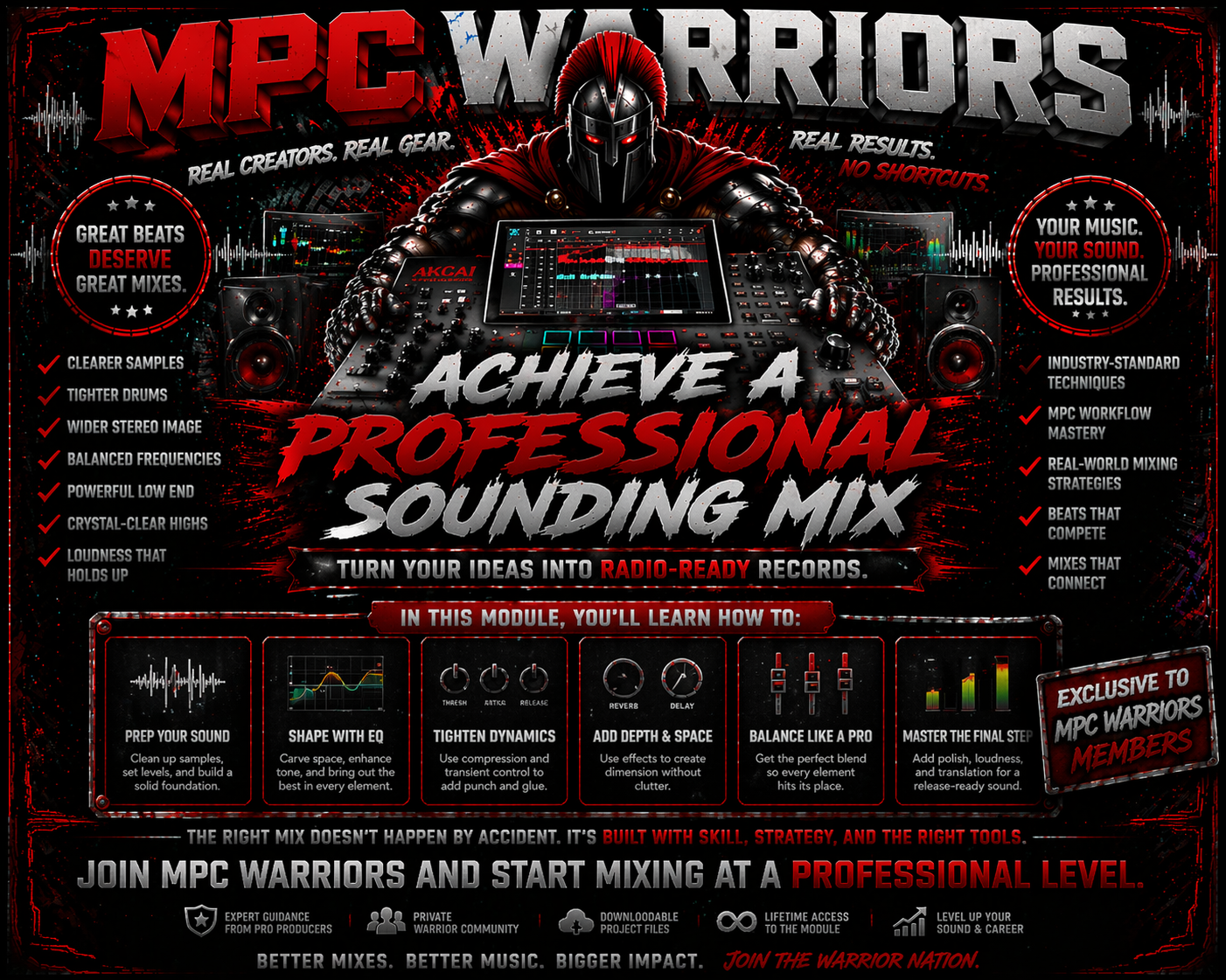
Join the MPC Warriors Elite Program.
- Learn real mixing workflows
- Understand sound selection
- Build industry-level clarity
- Get structured guidance
This isn’t just about making beats sound better.
This is about sounding like you belong.
Forge your sound. Control your future.