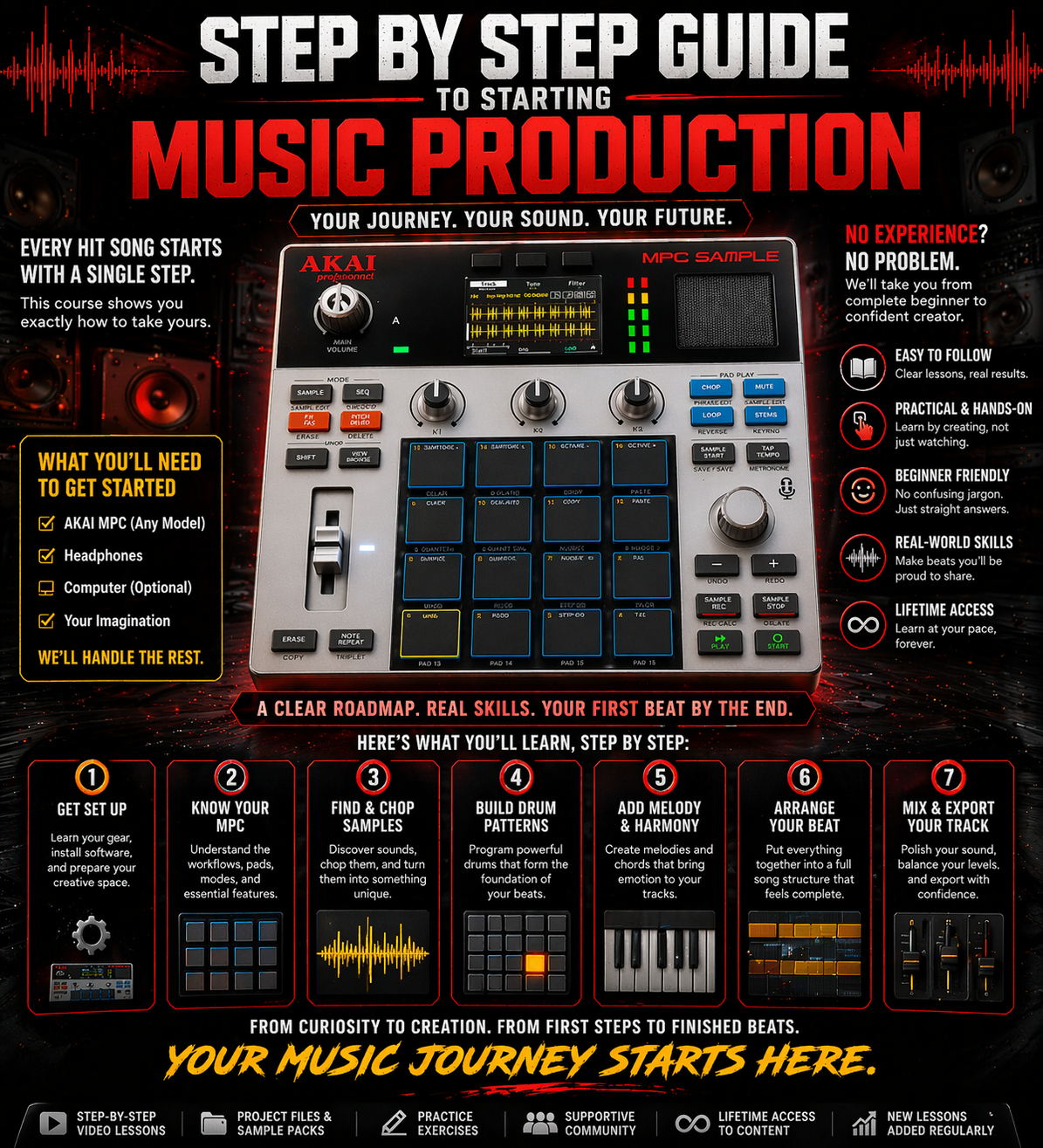
Step-by-Step Guide to Starting Music Production
Starting Before You Feel Ready
Music production can look overwhelming from the outside. You see finished records, polished beats, expensive setups, and creators moving with confidence, and it is easy to assume you need everything figured out before you begin.
You do not.
The truth is that most successful producers did not start with perfect equipment, perfect knowledge, or perfect confidence. They started with curiosity, limited tools, and a willingness to learn by doing. Music production is not something you fully understand before you begin. It is something you understand by entering the process.
If you want to start producing music, the goal is not to master everything immediately. The goal is to build a foundation that allows you to grow with clarity, consistency, and direction.

1. Understand What Music Production Actually Is
Before buying gear or downloading software, it helps to understand what music production includes.
Music production is more than making beats. It involves:
- Creating rhythms
- Building melodies
- Selecting sounds
- Arranging songs
- Recording audio
- Editing performances
- Mixing elements together
- Exporting a finished record
In simple terms, music production is the process of turning ideas into completed audio.
Some producers focus on instrumental production. Others produce full songs for artists. Others create music for podcasts, social content, video, or film. The field is wide, but the fundamentals remain the same: you are shaping sound into a structured experience.
The earlier you understand this, the easier it becomes to approach the craft seriously.
2. Choose a Starting Setup That Matches Your Reality
A major mistake beginners make is waiting until they have the “perfect setup.” That often leads to delay, confusion, and wasted money.
You only need a basic setup to begin.
A simple starting music production setup can include:
- A laptop or standalone device
- Headphones or speakers
- Production software or hardware
- A place to create consistently
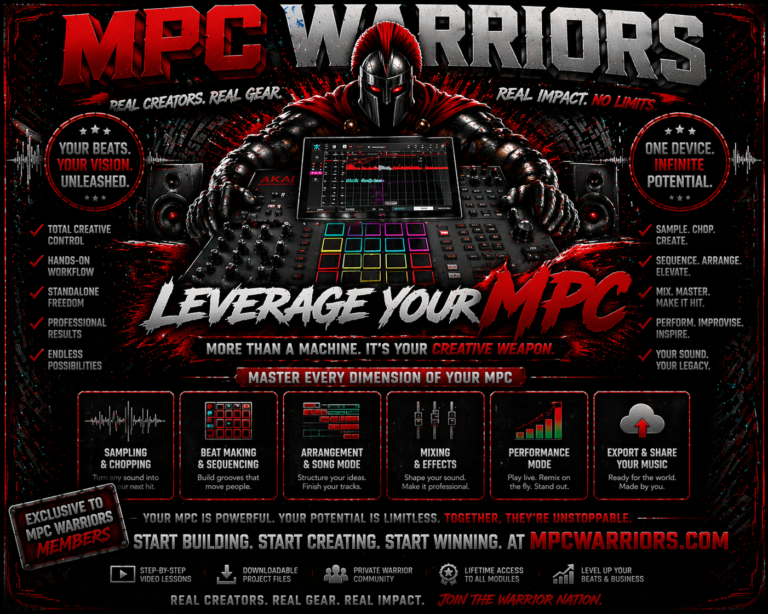
If you are using a computer, that often means choosing a DAW such as Ableton Live, FL Studio, Logic Pro, or another platform. If you are using an MPC, you may choose a standalone workflow that lets you create without relying heavily on a computer.
What matters most is not having the most gear. What matters is choosing a setup you can actually learn.
A simple setup you understand is more powerful than an expensive setup you barely use.
3. Learn Your Main Tool Before Chasing More Tools
Once you choose your setup, your next step is not to buy more plugins, more sounds, or more hardware. Your next step is to learn your core tool deeply.
If you are using an MPC, learn:
- Navigation
- Sampling
- Pad performance
- Sequencing
- Program creation
- Track arrangement
- Export workflow
If you are using a DAW, learn:
- How to create tracks
- How to load sounds
- How to record MIDI
- How to use the piano roll
- How to arrange a song
- How to bounce your work
Many beginners stay stuck because they constantly switch tools. They move from one tutorial to another, one plugin to another, one workflow to another. This creates motion without mastery.
Progress begins when you stop chasing everything and start learning one system well.
4. Start With Rhythm First
One of the easiest ways to begin making music is by starting with rhythm.
Drums teach structure quickly. They help you understand timing, movement, repetition, and groove. Even if your melodies are not strong yet, you can learn a great deal by building drum patterns.
Start by practicing:
- Kick placement
- Snare placement
- Hi-hat patterns
- Percussion layering
- Tempo awareness
Listen carefully to songs you enjoy and pay attention to how the drums move. Study where the energy comes from. A strong rhythmic foundation gives your music direction.
Beginners often think melodies are the hardest part. In many cases, the real strength of a track starts with the drums.
5. Learn How to Build Simple Loops
After rhythm, learn how to build a loop.
A loop is one of the most important early building blocks in music production. It teaches you how sounds interact and how ideas repeat in a musical way.
A simple loop may include:
- Drums
- Bass
- Chords
- Melody
- Texture or effects
Do not worry about creating a masterpiece. Focus on creating something coherent. Your first goal is not brilliance. Your first goal is completion.
A finished basic loop teaches more than an unfinished ambitious track.
This is how confidence starts to form: not from imagining, but from finishing.
6. Practice Arrangement Early
Many beginners learn how to make short loops but never learn how to turn those loops into songs.
This is where arrangement comes in.
Arrangement is the process of structuring your music so it moves over time. Instead of an 8-bar loop repeating endlessly, you create sections such as:
- Intro
- Verse
- Hook
- Breakdown
- Bridge
- Outro
Learning arrangement early matters because music is not just about sounds. It is about progression.
Ask yourself:
- When should energy rise?
- When should elements drop out?
- When should the listener feel tension or release?
Even simple arrangements teach musical storytelling. And storytelling is what separates random sounds from intentional production.
7. Train Your Ear, Not Just Your Hands
Music production is technical, but it is also deeply auditory. You are not only learning buttons and functions. You are learning how to hear.
Train yourself to notice:
- Whether drums feel too loud or too soft
- Whether melodies clash
- Whether the bass is muddy
- Whether transitions feel awkward
- Whether a section drags too long
This kind of listening takes time, but it is one of the most important skills you can develop.
A producer with trained ears can do more with limited tools than a producer with endless gear but poor judgment.
Listen actively, not passively. Study songs. Compare your work. Pay attention to detail.
8. Accept That Your Early Work Will Be Imperfect
This is one of the most important truths in the production journey.
Your early beats may sound rough.
Your arrangements may feel repetitive.
Your mixes may be weak.
Your ideas may not come out the way you hear them in your mind.
That is normal.
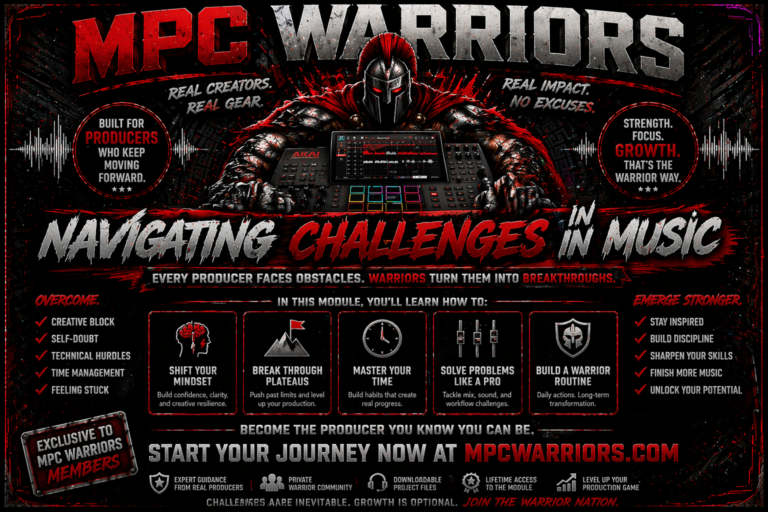
Perfectionism delays growth. The fastest way to improve is to produce, finish, evaluate, and repeat.
Bad early work is not evidence that you are not talented. It is evidence that you are learning.
Every skilled producer has old work they outgrew. That is part of the process.
You do not build mastery by avoiding weak output. You build it by surviving it.
9. Create Consistently Instead of Randomly
One of the biggest mistakes beginners make is relying on inspiration alone.
They produce when they feel motivated, then disappear for long stretches. That leads to inconsistency and weak progress.
Set a realistic rhythm.
For example:
- 30 minutes a day
- 3 focused sessions per week
- 1 finished idea every week
Consistency matters more than intensity.
You do not need to create all day. You need to create often enough that your skills stay active and your workflow stays familiar.
Momentum creates confidence. Repetition creates control.
10. Study Other Producers Without Losing Yourself
There is value in studying tutorials, watching workflow videos, and analyzing music from experienced producers. But you have to do this strategically.
Study to learn:
- How others structure beats
- How they layer sounds
- How they sample
- How they mix basic elements
- How they move quickly
But do not let study turn into paralysis.
Too much watching can become a substitute for creating.
Learn something, then apply it immediately. Let knowledge move through your hands, not just your eyes.
And while learning from others, remember this: the point is not to become a copy of someone else. The point is to build your own sound with stronger tools.
11. Learn Basic Mixing Fundamentals
You do not need elite engineering knowledge to start producing, but you do need to understand some mixing basics.
At a beginner level, focus on:
- Volume balance
- Panning
- EQ basics
- Reverb and delay
- Cleaning up mud
- Leaving space between sounds
A beat can have strong ideas and still lose impact if everything is fighting for room.
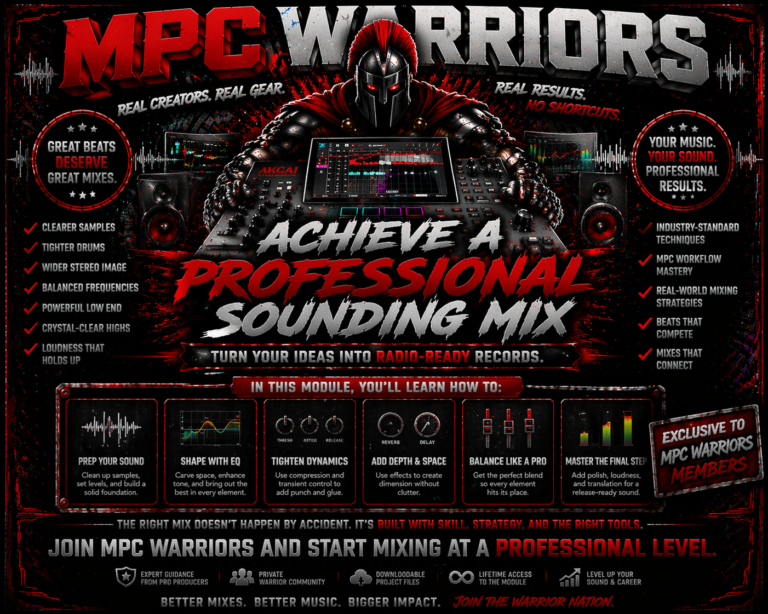
Mixing is not magic. It is the discipline of helping each sound sit where it belongs.
When you begin to understand that, your productions immediately feel more intentional.
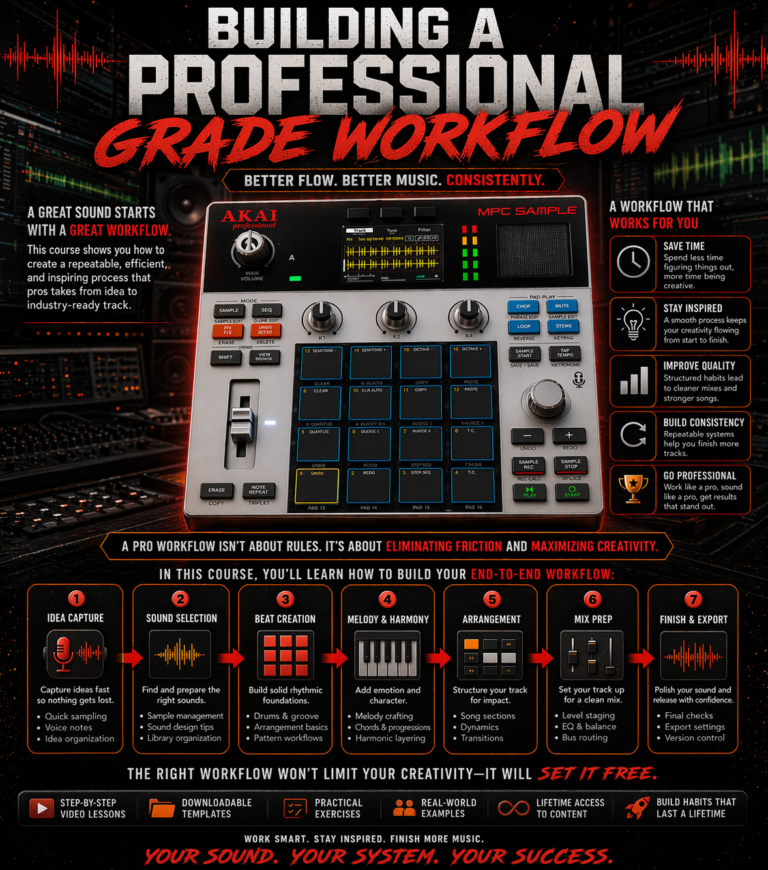
12. Build a Workflow You Can Repeat
The strongest beginner advantage is not talent. It is workflow.
A repeatable workflow may look like this:
- Start with drums
- Add bass
- Add chords or sample
- Add melody or texture
- Structure the loop
- Arrange the track
- Balance the mix
- Export and review
When you have a process, you waste less time wondering what to do next. A workflow removes hesitation.
This does not mean every session must be rigid. It means you need a reliable path when creativity feels unclear.
Structure reduces friction. Reduced friction increases output.
13. Share Carefully and Seek Useful Feedback
At some point, you should let other people hear your work. But be careful about where you seek feedback.
Not all feedback is useful. Some people do not understand the craft. Some judge based on preference, not quality. Some discourage because they lack vision.
Try to get feedback from:
- Other serious producers
- Artists who understand music
- Coaches or mentors
- Communities focused on growth
Ask better questions, such as:
- Is the arrangement flowing?
- Are the drums hitting right?
- Does the mix feel muddy?
- What stands out most?
- What should I improve next?
Useful feedback accelerates development. Random opinions often create confusion.
14. Begin Thinking Beyond Beats
As you improve, start thinking beyond making a beat and begin thinking like a creator.
Music production today connects to:
- Podcasting
- Social media content
- Beat videos
- Sample packs
- Courses
- Branding
- Performance
- Digital products
This matters because modern producers are no longer just technicians. They are creators with media potential.
The sooner you understand that your production skills can support a larger platform, the more valuable your journey becomes.
You are not only learning to make music. You are learning to create assets.
Conclusion: Start Small, Stay Consistent, Grow Serious
Starting music production is not about having the perfect setup, the perfect sound, or the perfect confidence level.
It is about beginning.
Choose a setup.
Learn your main tool.
Practice rhythm.
Build loops.
Arrange songs.
Train your ears.
Stay consistent.
Accept imperfection.
Keep improving.
That is the path.
The producers who grow are rarely the ones who waited until everything felt right. They are the ones who started, stayed with the process, and kept building through uncertainty.
Final Thought
You do not need to know everything to begin.
You need enough clarity to take the first serious step.
Music production rewards the committed. And every session you complete moves you further away from confusion and closer to control.
Call to Action
If you are ready to stop guessing and start building with structure, discipline, and a real workflow, step into the system with MPC Warriors.
Learn how to create music, podcasting content, and a full creative ecosystem with purpose.
Forge your sound. Control your future.