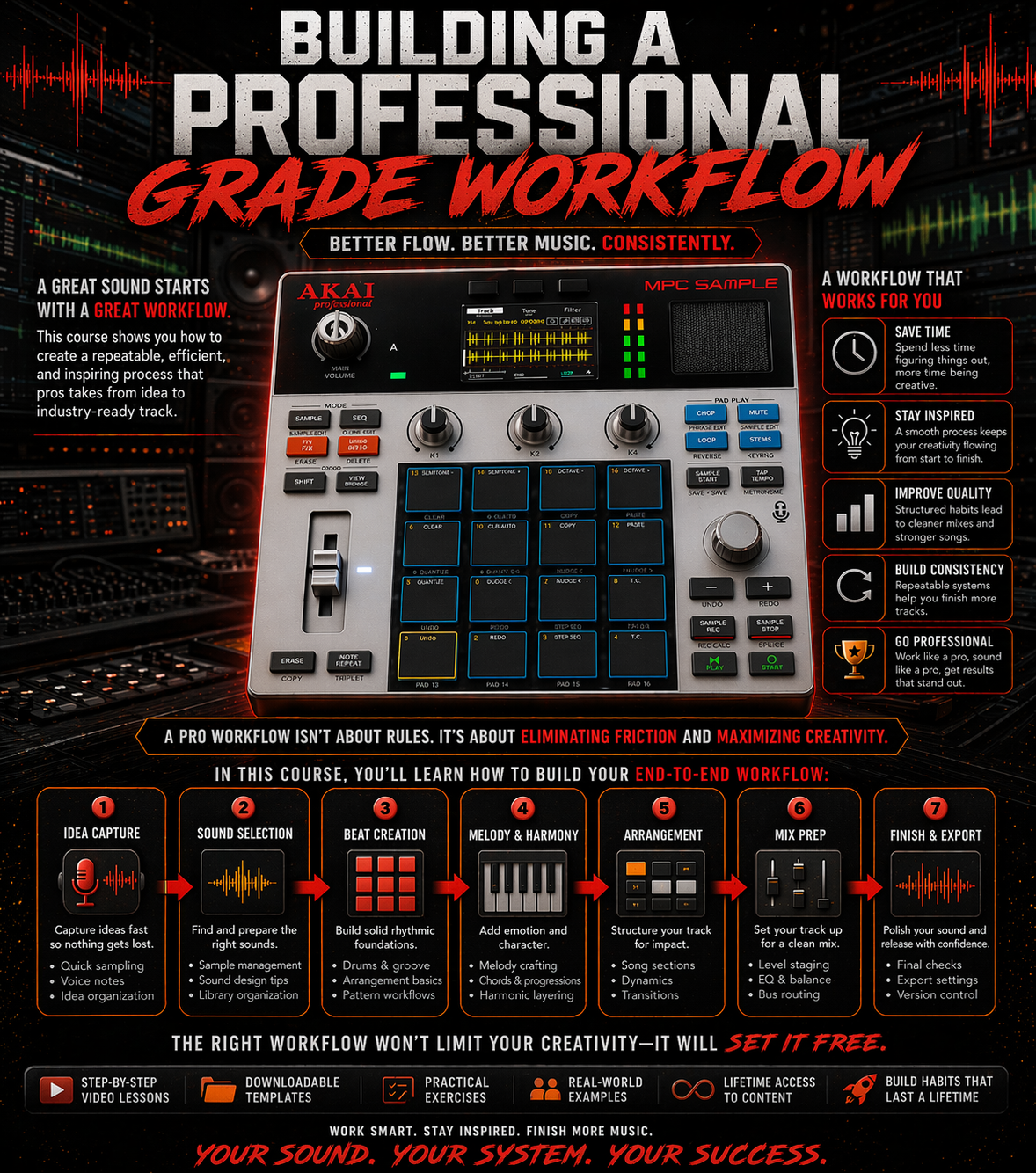
Top Tools Every Music Producer Should Know: Building a Professional-Grade Workflow
Tools Don’t Make the Producer—But They Shape the Process
In music production, there is a constant temptation to chase tools.
New plugins.
New gear.
New software.
But the truth is this:
Tools do not create skill—but the right tools, used correctly, can accelerate your growth, sharpen your workflow, and elevate your sound.
The goal is not to own everything.
The goal is to understand what matters—and use it with intention.
A professional producer does not rely on random tools.
They build a system.
1. Your Core Production Platform (DAW or Standalone System)
Every producer needs a central hub—the place where ideas become records.
This is your:
- DAW (Digital Audio Workstation)
or - Standalone system (like an MPC)
Examples include:
- Ableton Live
- FL Studio
- Logic Pro
- MPC standalone workflow
This is where you:
- Create beats
- Arrange tracks
- Edit audio
- Structure songs
Your first priority should be mastering one platform.
Switching between multiple DAWs early slows progress. Depth beats variety.
2. Drum Kits and Sound Libraries
Your sound is only as strong as your source material.
Drum kits and sound libraries provide:
- Kicks
- Snares
- Hi-hats
- Percussion
- One-shots
- Loops
High-quality sounds reduce the need for heavy mixing.
Instead of fixing weak sounds, you start with strong ones.
A focused, well-curated sound library is more valuable than thousands of random files.
3. Sampling Tools and Sample Sources
Sampling remains one of the most powerful creative techniques in music production.
Whether you are:
- Chopping samples
- Flipping melodies
- Extracting textures
You need tools that allow you to manipulate audio creatively.
This can include:
- Built-in samplers (MPC, DAW samplers)
- Audio editing tools
- Sample libraries
Sampling is not about copying—it is about transforming.
It allows you to create something new from something existing.
4. MIDI Controllers and Performance Tools
MIDI controllers bridge the gap between:
- Digital production
and - Physical interaction
They allow you to:
- Play melodies
- Trigger drums
- Control parameters in real time
Examples include:
- MIDI keyboards
- Pad controllers
- Integrated systems like the MPC
Hands-on control often leads to:
- Better creativity
- Faster workflow
- More natural musical expression
5. Monitoring: Headphones and Speakers
You cannot improve what you cannot hear accurately.
Monitoring tools include:
- Studio headphones
- Studio monitors
These help you:
- Hear detail
- Identify problems
- Make better mixing decisions
While you do not need the most expensive setup, you do need consistency.
Learn how your headphones or speakers sound—and use them as a reference point.
6. EQ: The Foundation of Clarity
EQ is one of the most essential tools in production.
It allows you to:
- Shape frequencies
- Remove unwanted sounds
- Create space in your mix
Every producer should understand:
- Low-end control
- Midrange clarity
- High-end presence
EQ is not optional—it is fundamental.
7. Compression: Control and Punch
Compression helps manage dynamics.
It allows you to:
- Control volume spikes
- Add punch to drums
- Smooth out performances
Used correctly, compression adds:
- Consistency
- Energy
- Professional polish
Used incorrectly, it can destroy your mix.
Understanding compression separates beginners from serious producers.
8. Reverb and Delay: Creating Space
Reverb and delay are your primary tools for creating depth.
They help you:
- Add atmosphere
- Place sounds in space
- Create movement
Without these tools, your mix will feel flat.
With them, your mix becomes:
- Wider
- Deeper
- More immersive
The key is subtlety and control.
9. Arrangement and Sequencing Tools
Creating a loop is one skill. Turning it into a full track is another.
Arrangement tools help you:
- Structure your music
- Build progression
- Control energy
This includes:
- Timeline editing
- Pattern sequencing
- Automation
Understanding arrangement is what transforms ideas into finished records.
10. Exporting and File Management
Many producers overlook this—but it is critical.
You need to understand:
- How to export your tracks
- File formats (WAV, MP3, stems)
- Proper naming and organization
A disorganized producer wastes time.
A structured producer builds efficiently.
Professionalism includes how you manage your files—not just how you create your music.
11. Content Creation Tools
Modern producers must think beyond music.
Content tools allow you to:
- Record your workflow
- Create videos
- Share your process
- Build your audience
This can include:
- Screen recording software
- Cameras or smartphones
- Editing software
Your production process can double as content.
This is how you turn skill into visibility.
12. Learning Resources and Communities
No producer grows in isolation.
You need access to:
- Tutorials
- Courses
- Communities
- Feedback systems
The right environment accelerates growth.
Instead of guessing, you learn:
- Proven workflows
- Structured approaches
- Real-world application
This is where many producers either stagnate—or level up.
Conclusion: Tools Are Only as Powerful as the User
You do not need every tool.
You need the right tools—and the discipline to use them well.
A professional producer:
- Understands their system
- Uses tools with purpose
- Builds consistency
- Focuses on execution
The difference between amateur and professional is not access—it is application.
Final Thoughts
The goal is not to collect tools.
The goal is to build a workflow where:
- Creation is fast
- Decisions are clear
- Output is consistent
When your tools serve your process, your process becomes powerful.
Warrior Wake Up
If you’re ready to stop guessing which tools matter and start building a real production system:
Join the MPC Warriors Elite Program.
- Learn the essential tools
- Master your workflow
- Build consistency
- Turn your setup into a system
This isn’t about having more tools.
This is about becoming more effective.
Forge your system. Control your future.